
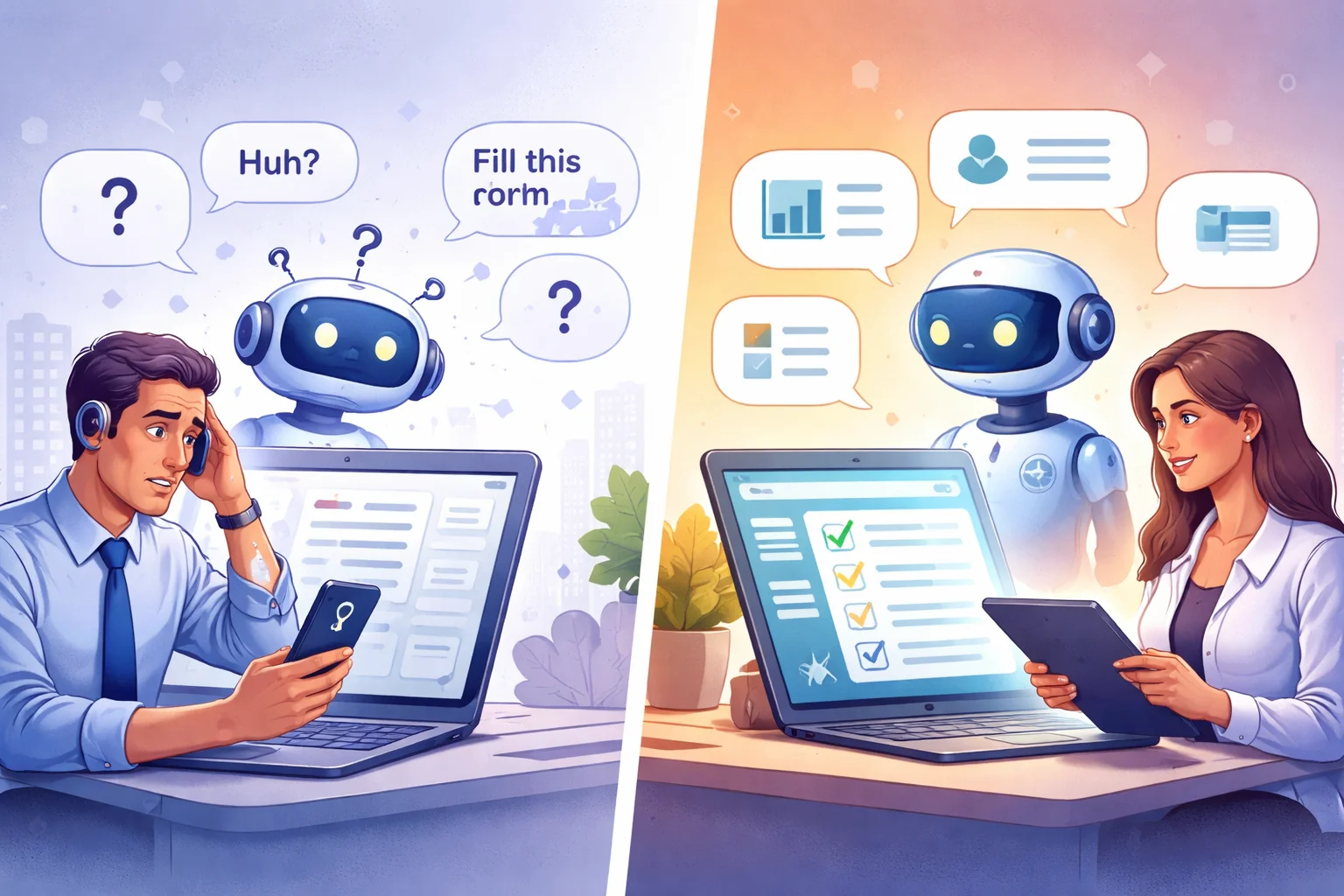
Over the past two years, the chatbot market has exploded. Along with it, confusion has grown: almost everything is now marketed as “AI,” while most tools deployed in companies are, in reality, conversational gadgets.
The result is predictable: frustrated leads, disappointed teams, and performance far below expectations.
Here is a clear, experience‑based analysis of the 10 fundamental differences between a gadget chatbot and a truly useful AI assistant in 2026.
1. A gadget chatbot follows a script, an AI assistant understands intent
Traditional chatbots rely on rigid scenarios and predefined keywords. As soon as users deviate from the expected path, the conversation breaks down.
A useful AI assistant interprets intent, even when the request is vague or poorly phrased.
2. The gadget answers, the AI assistant guides
A gadget chatbot simply answers questions. A useful AI assistant actively guides the conversation toward a meaningful outcome: qualification, relevant information, or smart routing.
3. The gadget is decorative, the AI assistant is strategic
Many chatbots are deployed to “look modern” without playing a real role in the conversion funnel.
A useful AI assistant is designed as a key step in the customer journey, with measurable impact on qualification and conversion.
4. The gadget collects data, the AI assistant uses it
Basic chatbots store answers. Useful AI assistants analyze behavior, hesitation, and weak signals.
5. The gadget frustrates, the AI assistant reassures
A chatbot that doesn’t understand or repeats itself creates frustration.
A useful AI assistant reduces cognitive effort and builds trust from the first interaction.
6. The gadget is isolated, the AI assistant is connected
Gadget chatbots operate in silos. Useful AI assistants connect to CRM, marketing, and sales tools.
7. The gadget treats everyone the same
Same message, same logic, same journey.
A useful AI assistant adapts its language and flow based on context and lead maturity.
8. The gadget promises, the AI assistant proves
Gadget chatbots are sold with vague promises.
A useful AI assistant is judged on concrete results: response rates, qualified leads, and created opportunities.
9. The gadget wastes team time
Poorly qualified leads waste sales teams’ time.
A useful AI assistant acts as an intelligent filter.
10. The gadget is a cost, the AI assistant is a lever
A gadget chatbot is an expense. A useful AI assistant becomes a profitable investment.
Conclusion
The real question is no longer “Do we have a chatbot?” but “Does our conversational assistant truly help prospects move forward?”
At Leadkong.com, the approach is built on this distinction: designing AI assistants focused on intent, qualification, and conversion — not decorative gadgets.