
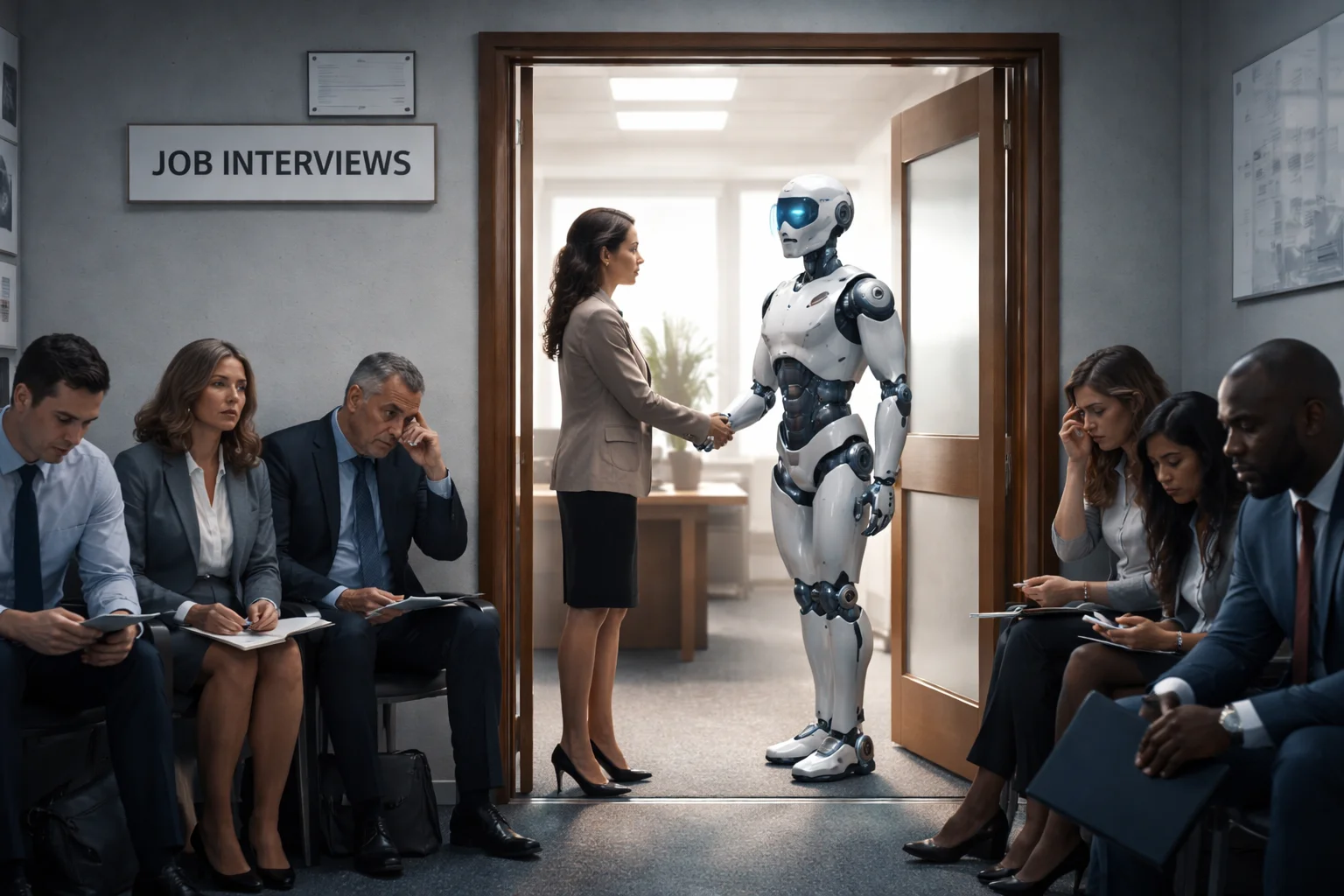
Since 2022, AI hasn’t triggered an employment apocalypse. It’s doing something more discreet and more corrosive. It slows down hiring, especially in exposed office jobs, and cuts off the social elevator at the junior level.
The numbers are starting to converge. Bank of England, Dallas Fed, IMF. Same diagnosis, same sequence.
In the jobs most exposed to AI, new job postings have dropped by about 40% since mid-2022—twice as much as in less exposed sectors. The gap isn’t closing. It’s settling in.
This shock doesn’t come through mass layoffs. It comes through something colder. Companies simply stop hiring.
The young pay the price
AI hasn’t yet massively replaced senior workers. It replaces junior workers before they even enter.
In the UK, by mid-2025, job postings in AI-exposed professions were 5.5% lower than the pre-ChatGPT trajectory. The impact is almost entirely concentrated on entry-level positions.
In the U.S., the Dallas Fed observes a drop of more than 3 points in young workers’ employment access rate in highly exposed fields. The phenomenon doesn’t fit a classic economic cycle. It’s a technological shock.
Simple translation: companies keep their experienced teams and automate what historically served to train beginners.
Recruiters automate while candidates burn out
Another blind spot in the debate: the recruitment market itself is now driven by AI.
By 2026, 93% of recruiters plan to increase their use of AI tools—sourcing, screening, pre-interviews. Two-thirds want to automate even more of the early stages.
The mechanical result: more candidates filtered faster, with more standardized criteria, while young applicants try to stand out with signals that models ignore.
Ironic but logical. AI filters candidates trained in a world where AI wasn’t yet the filter.
Not a collapse. A brutal reconfiguration of skills
Job cuts explicitly attributed to AI exist—about 55,000 in 2025, 72,000 since 2023 in the U.S. But they remain marginal compared to the total volume of restructuring.
The real signal lies elsewhere. Job offers mentioning AI have increased by 134% compared to 2020, while the overall job market remains almost stagnant.
AI doesn’t eliminate work. It changes the definition of employability faster than training and hiring systems can adapt.
What this means in practice
For young graduates
• Don’t position yourself as an “augmentable executor.” Bad strategy.
• Show an ability to frame, arbitrate, and control automated systems.
• Build evidence of real AI usage, not decorative certificates.
For HR
• Rethink junior career paths. Automation has erased implicit learning.
• Invest in hybrid roles instead of looking for “ready-to-work” profiles.
• Audit biases created by AI filtering tools. They already exist.
For policymakers
• The risk isn’t mass unemployment.
• The risk is a generation locked out of the labor market while productivity rises elsewhere.