
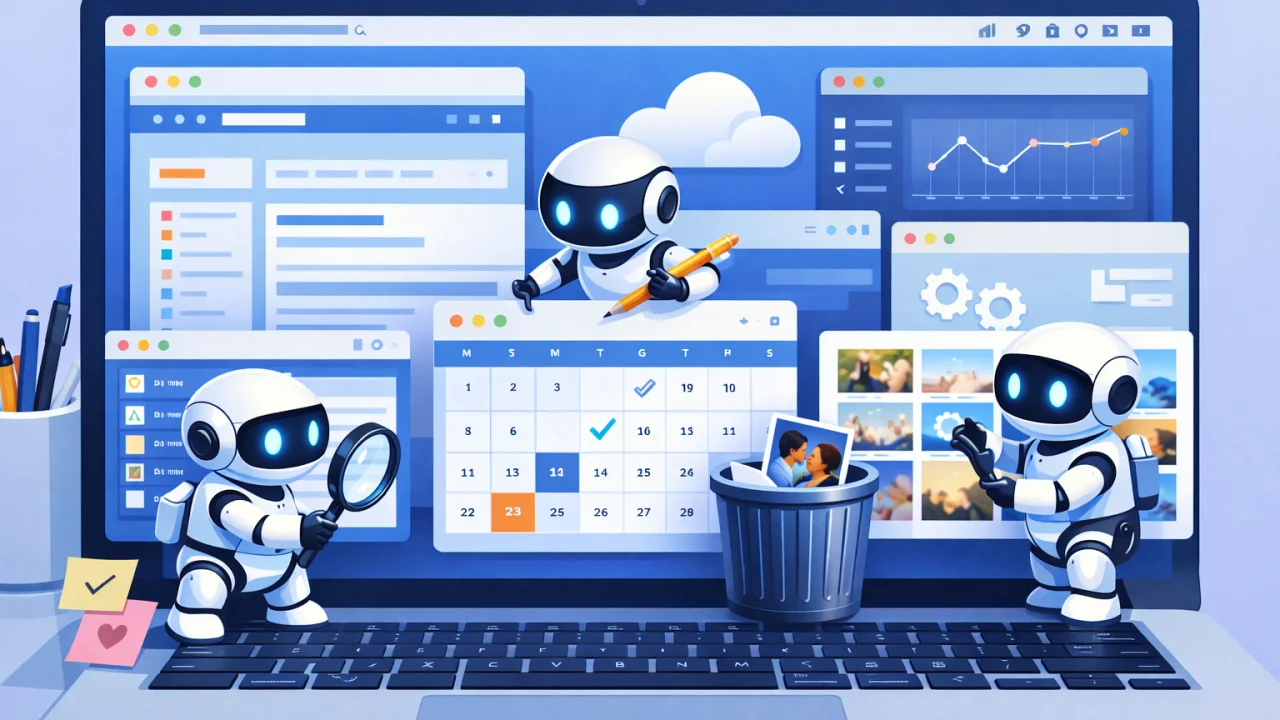
2025 will be remembered as the year AI became officially “agentic.” The term is overused, but the underlying shift is real: models don’t just answer questions anymore. They plan, break goals into steps, run iterations, correct themselves, and recover from errors — especially in software workflows.
But 2025 also exposed a structural limitation: planning isn’t execution. And the real world is not a clean, documented API.
That’s why 2026 may be less about “agents” as a concept, and more about a new generation of agents that can operate where real work happens: inside messy interfaces.
Two AI trajectories in 2026, two very different impacts
1) Physical-world AI (robotics)
Critical for robotics: perception, causality, manipulation, uncertainty. High strategic importance, slow mass adoption.2) Interface-native AI (mobile, desktop, OS)
This one is immediate. It targets smartphones, computers, operating systems — and the UI chaos we deal with daily. Instead of calling endpoints, it handles screens, states, permissions, animations, latency, silent failures, and cross-app flows.This is where near-term consumer impact is most likely.
From agentic AI to interface-native AI: what changes?
Interface-native AI is designed to operate interfaces, not APIs:
- it “sees” screens (pixels / UI elements),
- interprets visual states,
- handles latency and transitions,
- deals with permissions, pop-ups, WebViews,
- survives inconsistent UI behavior.
That’s the 2026 break: agents become truly useful when they can reliably act outside controlled toolchains.
“Split brain” architecture: why intelligence is local + cloud
A key pattern behind interface-native AI is a split architecture:
- on-device: perception, fast execution, short loops, security boundaries, responsiveness.
- cloud: heavier planning, deeper reasoning, long-term memory, complex decisions.
Benchmarks are changing: from “correct answers” to “completed tasks”
This shift shows up in new benchmarks that measure task completion:
- AndroidWorld benchmarks agents doing tasks in a reproducible Android environment.
- MobileWorld (paper) pushes closer to real-world difficulty.
Further reading:
Apple Intelligence: an accidental demonstration of the interface problem
Apple positioned Apple Intelligence as a new layer of understanding for the iPhone. In practice, the experience has felt limited at times — not necessarily due to lack of talent, but because interface-native AI is a systems problem:
- on-device AI costs battery, heat, memory.
- cloud AI introduces latency, privacy, and security constraints.
AI browsers: useful isn’t the same as “system-operational”
AI browsers can be impressive, but many are still fundamentally browser-centric:
- they operate mainly in the DOM,
- reliability drops when tasks span native apps, permissions, or multi-step flows.
Example:
The China factor: “system-first” AI (device + cloud + training loops)
A major competitive angle is system-level design: device + cloud + perception + reinforcement loops in realistic environments. Some Chinese teams push aggressively on this exact axis, prioritizing robust pipelines over flashy demos.
For interface-native AI, the “system” often matters as much as the model.
What becomes realistic by the end of the year
If this trajectory holds, we’ll see mobile OS experiences that are genuinely AI-augmented, not just AI-decorated.
Plausible workflows:
- scan emails and propose meeting slots based on context,
- clean photo libraries (duplicates, clustering by time/person),
- prepare meeting notes across multiple apps,
- organize folders, attachments, and documents.
What we believe at Leadkong
At Leadkong, we believe 2026’s real shift is action-first AI:
- not just talking,
- not just planning,
- but executing reliably in the messy reality of everyday software.
Conclusion – 2025 made agents visible, 2026 may make them operational
2025 popularized agentic AI: planning, reasoning, iteration.
2026 could be the year agents become genuinely useful by mastering what matters most:
interfaces, where real work and real digital clutter live.
Agents were impressive.
Interface-native AI can make them operational.