
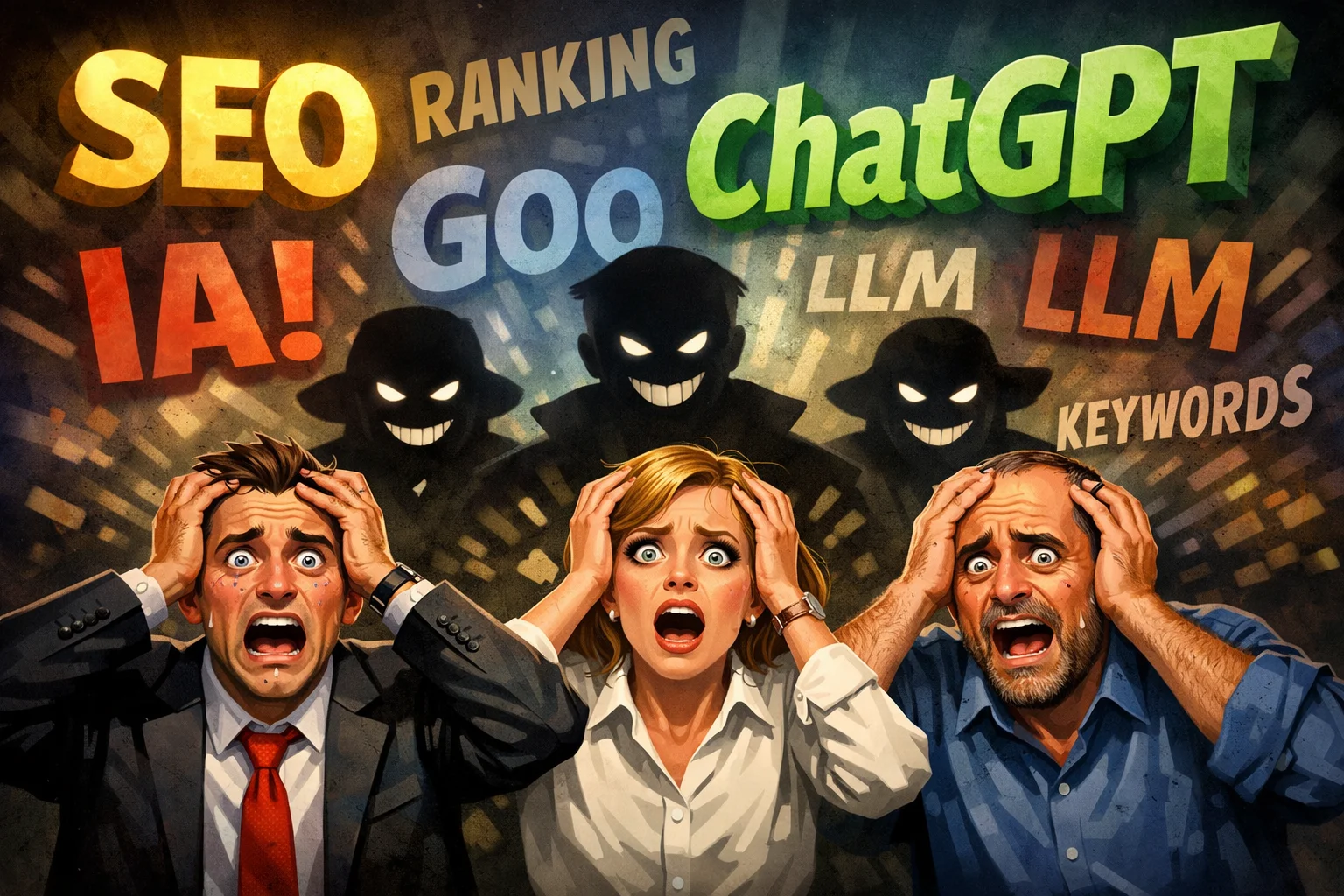
Since late 2024, weak signals have turned into obvious reality. Traditional SEO tactics built on keyword stuffing, long-form filler content, and automated backlink schemes are no longer delivering results. Organic traffic is shrinking and highly optimized content performs worse month after month.
As numbers drop, companies panic. The instinctive reaction is always the same: call a consultant, urgently.
A rush toward “AI SEO” that nobody fully understands
Across the field, there is chaos. SEO agencies are flooded with requests to “rank in AI results”. Translation: business owners see traffic declining and hope that ChatGPT, Perplexity, or other models can restore visibility.
Two groups are emerging:
- consultants who admit we are in a transition
- agencies trying to exploit fear and sell magic “AI SEO” packages
Old SEO is fading, but the replacement isn’t ready yet
Google is rewriting the rules:
- no more over-optimized robotic content
- emphasis on human-focused writing
- expertise, accuracy and genuine value
- LLMs siphon informational queries
- users get answers without clicking websites
- SERP visibility becomes fragmented
Should companies stop investing in SEO? Not exactly.
Throwing money at “AI SEO” today is risky. Models change fast and results are unpredictable. A safer approach is diversification:
1. Maintain essential SEO
Clean structure and useful content.
2. Strengthen controllable channels
Social reach, newsletters, expert content.
3. Buy measurability where needed
High-intent ads that convert.
Who wins in the transition?
Businesses surviving the turbulence:
- stop believing in silver bullets
- build their owned audience
- rely on multiple acquisition channels
Conclusion
SEO is not dead. It is evolving into something broader and less predictable.
The end of old-school SEO marks the end of passive acquisition.
Future winners will invest in content, brand and audience, while treating AI as an opportunity — not a panic button.